

Overview
FENIX gives you that flawless ultra-matte finish without the fingerprint anxiety. The nano-technology surface resists smudges, cleans with a damp cloth, and can thermally heal superficial micro-scratches, perfect for busy Wimbledon households who want modern style that lives up to real life. Kitchen Revolutions handles everything from initial design consultation through to installation, all locally managed. Ready to see samples and discuss your space? Book a design appointment at our Wimbledon showroom and we’ll map out exactly what works for your home.
When you’ve settled on the ultra-matte FENIX look for your kitchen, the practical questions come next: will it mark easily? How does it hold up against painted alternatives? What’s the actual process from first visit to finished kitchen? If you’re in Wimbledon, Southfields, Raynes Park or surrounding South London areas, Kitchen Revolutions manages FENIX projects from design consultation through to installation, and you can see real door samples, worksurface pairings and lighting combinations at our Wimbledon kitchen showroom before committing to anything.
FENIX has moved beyond niche specification into mainstream consideration for families and professionals who want that clean, contemporary aesthetic without constant upkeep. The surface technology addresses the two biggest concerns with matte finishes: visible fingerprints and vulnerability to scratching. Here’s what makes it work in real kitchens, how it compares to other options, and what to expect when working with us locally.

Why FENIX Works in Real Kitchens
The appeal starts with the visual, soft, light-absorbent, no glare, but the engineered properties are what make FENIX practical for daily use:
Ultra-matte, low-reflectance surface
The finish reads as smooth and uniform under any lighting. No sheen variation, no pooling highlights on larger door panels. This consistency is why FENIX pairs so naturally with handleless kitchen designs where uninterrupted surfaces are the whole point.
Anti-fingerprint nano-technology
Oils from skin contact don’t adhere the way they do on standard painted or lacquered doors. You’ll still see marks if you deliberately smudge it, but normal touch, opening doors, leaning against an island, leaves minimal trace.
Non-porous and easy to clean
The surface is sealed at a microscopic level, so spills, splashes and cooking residue sit on top rather than soaking in. A damp microfibre cloth handles most daily cleaning. For tougher spots, a gentle all-purpose cleaner works without dulling the finish.
Thermal healing of superficial micro-scratches
Light surface scratches, the kind that accumulate from everyday contact, can often be reduced or erased using a domestic iron and a cloth (the heat causes the nano-particles to re-bond). This isn’t magic: deep gouges won’t disappear, but superficial marks that would be permanent on painted doors can be addressed at home.
Sustainable material options
Many FENIX variants use bio-based content and water-based adhesives, with EPD (Environmental Product Declaration) certification. If sustainability factors into your decision, we can talk through which FENIX lines meet specific environmental criteria.
These aren’t marketing exaggerations, they’re engineered characteristics of the material. That said, FENIX is still a laminate product applied to engineered substrate, not an indestructible surface. Treat it reasonably and it performs exceptionally well.
FENIX vs Alternatives
If you’re weighing FENIX against other matte or modern finishes, here’s how they compare in practical terms:
FENIX vs Painted or Matt Lacquer Doors
Painted doors, whether sprayed MDF or lacquered timber, give you unlimited colour matching and a beautifully smooth finish. But fingerprints show more readily, and any chips or scratches require professional touch-up or respraying. Matt lacquer finishes can be delicate; some require specific cleaning products to avoid streaking or dulling. FENIX trades the bespoke colour flexibility for better day-to-day resilience and easier maintenance. If you’re set on a very specific shade, paint may still be the right choice. If you’re happy within FENIX’s colour range (which is extensive), the durability advantage is significant.
FENIX vs Standard Laminate
Traditional laminate kitchen doors are hardwearing and affordable, but the finish is usually satin or textured rather than ultra-matte, and the edges are more vulnerable to moisture ingress over time. FENIX is a premium laminate, thicker, more sophisticated surface structure, better edge sealing, so it costs more but delivers a finish quality closer to lacquer than to builder-grade laminate.
FENIX vs Ceramic or Stone-Effect Fronts
Large-format ceramic fronts offer extreme durability and authentic material texture, but they’re heavy, expensive, and require careful handling during installation. FENIX gives you a contemporary matte aesthetic at a lower price point and with less structural load, useful if you’re working within existing cabinetry or weight constraints. For those drawn to the tactile quality of natural materials, ceramic or stone may still feel more satisfying; FENIX is the pragmatic choice when you want modern minimalism without the cost or complexity of large-format ceramics.
The decision usually comes down to budget, colour preference, and how much daily contact your doors will see. For families with young children or anyone who cooks frequently, FENIX’s fingerprint resistance and thermal healing tip the balance.
Design Directions that Pair with FENIX
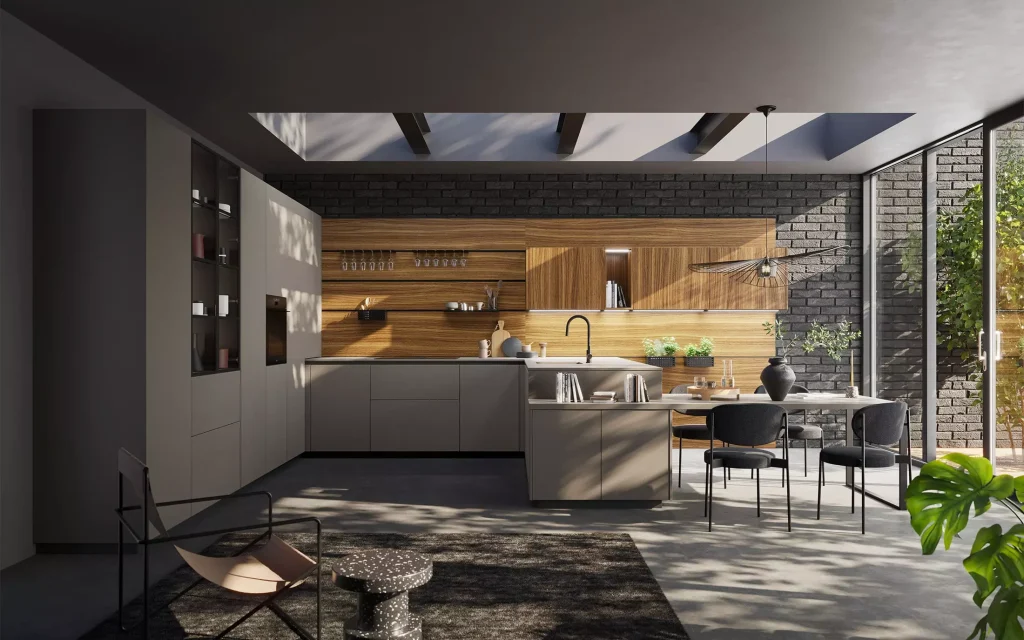
FENIX works across multiple kitchen styles, but it’s most at home in modern and contemporary schemes where clean lines and material restraint are central.
Handleless and Minimalist Layouts
The uniformity of the FENIX surface makes it ideal for handleless kitchen cabinets with push-to-open mechanisms or integrated profiles. No hardware to interrupt the plane, no fingerprint halos around handle positions. If you’re planning a sleek, gallery-like space, FENIX delivers that visual quiet better than almost any other finish.
Island Kitchens and Open-Plan Living
When your kitchen opens into a living or dining area, the island often becomes the focal point. A FENIX island in graphite, nero, or one of the warmer greys anchors the space without dominating it. The matte finish absorbs light rather than reflecting it, so the room feels calm even when the island is substantial in size. Pairing FENIX island cabinetry with contrasting worksurfaces, Dekton, quartz, or natural stone, adds layering without visual clutter.
Coordinating Worksurfaces, Splashbacks and Lighting
FENIX fronts work beautifully alongside a range of worksurface materials. Quartz in lighter tones provides contrast; dekton or sintered stone in similar matte finishes creates a monolithic effect; natural timber or textured stone adds warmth. For splashbacks, consider large-format porcelain, back-painted glass, or extending the worksurface material up the wall, all let the FENIX cabinetry remain the dominant surface. Lighting is critical with matte finishes: avoid harsh overhead spots that create uneven shadows; instead use integrated LED strips under wall cabinets, in plinths, or within open shelving to create even, ambient illumination. Task lighting over the worksurface ensures functionality without glare.
Appliance Integration
FENIX pairs naturally with flush-fitted appliances, particularly when you want integrated fridges, dishwashers and ovens to disappear into the run of cabinetry. For extraction, a BORA downdraft system eliminates the need for a visible overhead hood, preserving sightlines in an open-plan space and complementing the uncluttered aesthetic FENIX cabinetry delivers.
If you’re uncertain which direction suits your space, a design consultation lets us mock up different approaches with real samples. You’ll see how FENIX responds to your existing lighting, how it sits alongside flooring and worksurface options, and whether it feels right for your household’s rhythm.
How We Work in Wimbledon
We manage FENIX kitchen projects from the first conversation through to final handover, all coordinated locally. Here’s the typical sequence:
Book a design appointment to start the process.
1. Showroom Consultation
You visit our Wimbledon kitchen showroom to see FENIX samples, explore colour options, discuss layout ideas and talk through appliances, worksurfaces and lighting. We’ll ask about how you use your kitchen, what matters most (storage, prep space, seating), and any constraints (budget, timelines, structural limitations). This session is exploratory, no pressure, no obligation. It’s where we establish whether FENIX suits your needs and start shaping a design direction.
2. Home Measure and Site Survey
We visit your property to take detailed measurements, check services (plumbing, electrical, gas), assess structural factors (load-bearing walls, ceiling height, window positions), and discuss any spatial changes you’re considering. This survey informs the technical design and highlights anything that needs attention before installation. If you’re in Wimbledon, Southfields, Raynes Park, Merton, Putney, Tooting, Mitcham, Earlsfield or nearby, we handle this as part of the standard process at no extra charge.
3. Design Proposal and Quotation
We prepare a full proposal with scaled drawings, 3D renderings, itemised specification (cabinetry, worksurfaces, appliances, lighting, handles or push-to-open systems), and a fixed-price quotation. You’ll see exactly what’s included, what lead times look like, and what the payment schedule entails. We refine the design through revisions until you’re completely satisfied, then move to ordering and scheduling.
4. Installation and Handover
Our installation team strips out the existing kitchen (if applicable), coordinates trades (electrician, plumber, plasterer, tiler), fits the new cabinetry, templates and installs worksurfaces, connects appliances, and completes all finishing details. We manage the entire process so you have a single point of contact throughout. At handover, we walk you through care and maintenance, demonstrate appliance functions, and provide all relevant documentation and warranties.
Book a design appointment at our Wimbledon showroom to begin.
Areas We Cover
Kitchen Revolutions is based in Wimbledon and works throughout South London and surrounding areas. We regularly manage projects in:
- Wimbledon Village and Wimbledon Park
- Southfields and Earlsfield
- Raynes Park and Motspur Park
- Merton and Colliers Wood
- Putney and Roehampton
- Tooting and Balham
- Mitcham and Morden
If you’re slightly further afield, towards Richmond, Kingston, Wandsworth, or Clapham, we can still help. Distance isn’t usually a barrier; it’s more about ensuring we can provide the same level of local support throughout the project.
Pricing and Next Steps
FENIX kitchens sit in the mid-to-premium price bracket. The material itself costs more than standard laminate but less than hand-painted or large-format ceramic fronts. Total project cost depends on kitchen size, layout complexity, choice of worksurfaces, appliances, and any structural work required.
If you’d like a rough sense of budget before booking a consultation, use our price estimator tool, it gives indicative pricing based on typical configurations. For a more detailed overview of what’s possible within different budgets, request our project brochure, which includes recent installations and specification notes.
The most effective next step is to visit the Wimbledon kitchen showroom. You’ll see FENIX samples in context, discuss your project specifics with a designer, and get a realistic sense of timelines and costs. If you prefer, we can arrange a home measure first to assess your space, then follow up with a showroom visit to review design options.
Book a design appointment to start the conversation.
FAQs
Q: Is FENIX suitable for busy family kitchens, or is it too delicate?
A: FENIX is more robust than most matte finishes. The anti-fingerprint surface and thermal healing of micro-scratches make it practical for daily family use, certainly more forgiving than painted or matt lacquer doors. It’s not indestructible, but it’s designed for real-world contact, not just showroom display.
Q: How do you repair superficial marks or scratches on FENIX?
A: Light surface scratches can often be reduced or removed using a domestic iron (set to medium heat) and a soft cloth, the heat causes the nano-particles to re-bond. This works for superficial marks; deeper scratches or gouges can’t be healed at home and would require panel replacement. It’s a useful feature, but not a cure-all.
Q: How does FENIX compare to painted kitchen doors in terms of cost and longevity?
A: FENIX typically costs similar to or slightly less than high-quality sprayed and lacquered doors. It’s more resistant to fingerprints and easier to maintain day-to-day, but you’re limited to the manufacturer’s colour range. Painted doors offer unlimited colour matching but require more careful cleaning and professional repair if damaged. Longevity is comparable if both are treated reasonably.
Q: Where can I see FENIX samples and colours in person?
A: Visit our Wimbledon kitchen showroom, we stock a range of FENIX door samples, including the most popular colours (graphite, nero, beige, warm greys), and we can order additional swatches if you’re considering something less common. Seeing the finish under different lighting conditions is essential before committing.
Q: What are typical lead times for a FENIX kitchen, and how can I get an exact timeline?
A: From order confirmation to installation start, expect 8–12 weeks for most FENIX projects (cabinetry manufacture, worksurface templating, appliance delivery). This can vary with project complexity and time of year. Once we’ve completed your design and specification, we’ll provide a detailed project timeline with key milestones. Book a design appointment to discuss your specific schedule.